
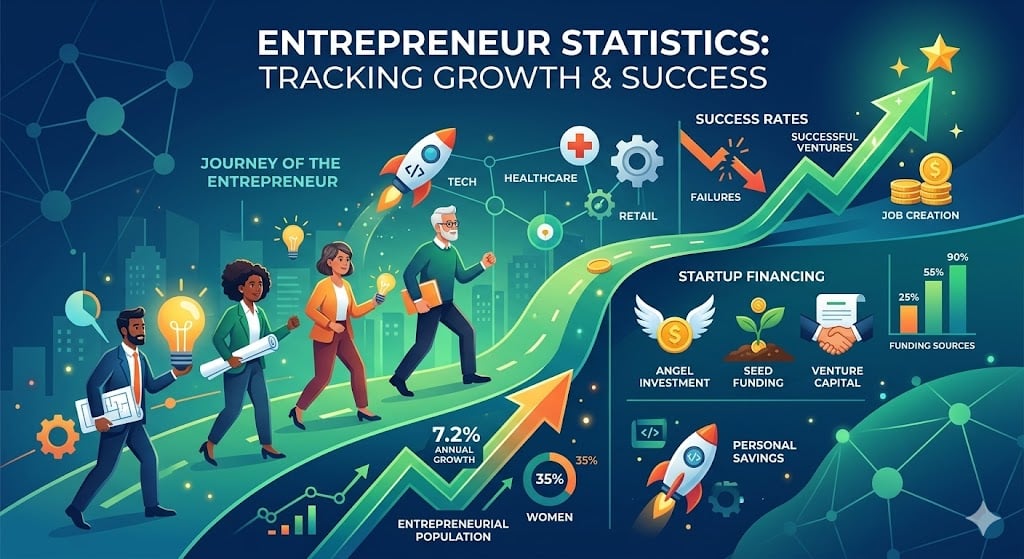
Entrepreneurship is a gutsy career path that takes determination, hard work, and confidence. It comes with significant risk and a small chance of success. One key to success is knowing the facts before you dive in, and statistics are a great way to understand what you’re diving into.
People turn to entrepreneurship because 29% want to be their own boss. However, about 20% of businesses fail within the first year if there’s no market for their product or service. To be a successful entrepreneur, 38% said that self-discipline is the key and 37% said people and communication skills.
In this article, we’ll give you more fascinating statistics about entrepreneurship and small businesses. You’ll learn more about the factors that lead to entrepreneurial success as well as the common reasons why small businesses fail.
General Small Business and Entrepreneurship Statistics
Why Businesses Fail
According to the Bureau of Labor Statistics and Guidant Financial, about 20% of businesses fail within the first year, and 50% fail within the first five years. The most common reason businesses fail is that there’s no market for their product or service (42%).
Capital or cash flow to sustain the business (29%) comes in second, while poor teamwork and communication (23%) ranks third on the list. Effective communication methods, such as business text messaging, can help streamline internal collaboration and improve customer engagement, reducing the risk of failure.
Therefore, if you wish to stand out amongst the crowd, make sure you offer a product or service that people need, understand your finances, and create an environment of teamwork and camaraderie. It’s also worth noting that investing in proper tools, such as omnichannel support software, a CRM, etc., can significantly enhance efficiency and improve customer experience.
For many founders looking to scale without losing control, implementing structured EOS software for your business is another critical step to ensure that team communication and strategic goals remain aligned as the company grows, ultimately giving your business a competitive edge.
Reasons Why People Become Entrepreneurs
There are many reasons why someone would want to start their own business and platforms like Whop make it easier to turn those ideas into reality.
According to Guidant Financial, about 29% of entrepreneurs say they chose this path because they wanted to be their own boss. This is constantly the number one reason why entrepreneurs start their businesses.
The second most popular reason entrepreneurs start their businesses (about 17%) is that they are dissatisfied with corporate America and it requires no degree to start a business. And a third reason is to pursue their passions (16%).
Top Challenges for Entrepreneurs
Entrepreneurship comes with a unique set of challenges that normal employees don’t necessarily need to think about. According to Guidant Financial, the top three (excluding COVID) are insufficient capital or cash flow (23%), recruiting employees (19%), and marketing (15%).
To tackle marketing more effectively, many startups benefit from using a Social Media Management Tool for Entrepreneurs, which helps streamline content, boost engagement, and improve brand name visibility.
Biggest Factors for Success
There are many factors involved when a small business becomes successful. According to National Business Capital and Services (NBCS), about 38% of entrepreneurs said that self-discipline was the key to their success. Entrepreneurs need to stick to their priorities, avoid distractions, and always aim for their goals, no matter what obstacles they face.
For those looking to diversify or secure global mobility, exploring the best Caribbean citizenship by investment options can be a strategic step toward personal and business freedom.
The next biggest factors for success were communication skills and passion, and drive.
Interestingly enough, the top factor of success for female entrepreneurs was people and communication skills (37%). However, self-discipline was their number two reason for success (34%), with money management skills coming up in third.
Entrepreneur Demographics
Typical Age Range of an American Entrepreneur
There’s no age requirement when you decide to start a business and you don’t have to decide is a business degree worth it.
Anyone from 18 to 80 with an idea and determination can be an entrepreneur. Although business owners come in all ages, according to NBCS, 35% of entrepreneurs and small business owners are in the 50-59 age bracket, followed by 40-49-year-olds. In fact, about 60% of people who start small businesses are between the ages of 40-60.
Inclusive Entrepreneurship
America’s business owners are more diverse than ever. According to the Small Business Administration (SBA), 17.7% of all employer firms were minority-owned:
- 5.6% Hispanic
- 2.2% African American
- 9.7% Asian
- 0.4% Native American
- 0.1% Native Hawaiians and other Pacific Islanders
What’s more, as of 2017, one in six business owners (17%) were immigrants.
Female Entrepreneurship
According to the Global Entrepreneurship Monitor, there are 252 million female entrepreneurs in the world. Even though more and more women are becoming entrepreneurs, according to Guidant Financial, currently, only 27% of small business owners in the United States are women.
According to the Global Entrepreneurship Monitor, about 71% of these women start a business to make a difference. Only 63% of men start a business for the same reason. Moreover, 65% of women entrepreneurs choose this path to make a high income as opposed to 73% of men.
The third most popular reason why women become entrepreneurs is to earn a living because jobs are scarce (45%).
Education
College degrees aren’t as important to entrepreneurs as regular employees. According to Guidant Financial, about 30% of entrepreneurs only finish high school, 31% have an associate degree, 17% have a bachelor’s degree, 18% obtained a master’s degree, and 4% have a PhD.
Formal education can help many career paths but doesn’t seem to be very important for entrepreneurship.
Entrepreneurship in the United States
Number of Entrepreneurs in the United States
According to the Global Entrepreneurship Monitor, there are 31 million entrepreneurs in the U.S., which is about 16% of the adult workforce. However, about 55% of adults have started a business at some point in their lives, and 26% have started two or more businesses.
This upward entrepreneurial activity reflects trends often discussed in futurist speaker statistics by Daniel Burrus, who points out that rapid innovation and future driven opportunities continue to motivate more individuals to explore business creation and multiple ventures.
In general, entrepreneurship is viewed positively in America, with 63% of Americans believing that it’s a good career choice.
Popular Industries for Entrepreneurship in the United States
According to Guidant Financial, the five top industries to see new small businesses in the United States are Food and Restaurant (12%), Retail (11%), Business Services (11%), Health Beauty and Fitness (9%), and Residential and Commercial Services (7%).
Since these industries are the most popular, they’re also the most competitive. However, you’re more likely to get financial backing and see success because these industries are in high demand.
The Economics of American Small Business
According to the SBA, there are 31.7 million small businesses in the U.S. and only 20,139 large businesses, which means small businesses account for 99.9% of all the businesses in the country.
They’re the lifeblood of the American dream, making up 50% of the economy. From 2000-2019, small businesses created 10.5 million net new jobs while large enterprises only created 5.6 million. Small businesses make up 65.1% of all new jobs created and employ 47.1% of all private-sector employees.
Financial Aspects of Entrepreneurship
How Are Small Businesses Financed?
There are many ways that a business can get financed. According to Guidant Financial, the most popular method in the U.S. (37%) is cash. About 13% of entrepreneurs used rollovers as business startups (ROBS) to finance their business.
After that, entrepreneurs either relied on their friends and family (10%), used unsecured loans (9%), or used a U.S. Small Business Administration loan to start their business.
In addition to traditional financing, many entrepreneurs also explore alternative lending solutions through lenders such as Newfi , especially when seeking options that better align with non-traditional income or evolving business cash flow.
How Many Businesses Are Profitable?
It’s one thing to start a business; it’s another to make it profitable. According to NBCS, Only 40% of small businesses yield a profit. About 30% of businesses break even while the final 30% lose money.
This fact should highlight the importance of financial forecasting and management when starting up a new business.
For example, in the healthcare or veterinary industry, this planning is critical for answering the ultimate question: “How do I maximize value before I sell my veterinary practice?
The Average Income of an Entrepreneur
Though many entrepreneurs do see some financial success, many of them rarely become millionaires or billionaires.
According to the SBA, the median income for self-employed owners of incorporated small businesses is $51,816 per year, while the median income for owners of unincorporated businesses is $26,084. Keep in mind that many entrepreneurs work side gigs or are not fully self-employed, which may skew this data.

The Rise of AI and Technology in Entrepreneurship
Artificial intelligence is reshaping what it means to run a small business, and entrepreneurs who understand this shift are positioning themselves ahead of the curve.
According to Forbes small business data, 77% of small business owners say they plan to use or are already using AI tools to streamline operations, reduce overhead costs, and compete with larger companies. From automating customer service to generating marketing content, AI has lowered the barrier to entry across nearly every industry.
The financial impact is significant. McKinsey global research estimates that small businesses leveraging AI tools see an average productivity increase of 40% compared to those that do not, allowing lean teams to punch well above their weight.
E-commerce entrepreneurship has seen some of the most dramatic AI driven growth. According to Shopify commerce data, the number of solo entrepreneurs running six figure online businesses grew by over 30% between 2022 and 2024, largely attributed to AI tools handling tasks that previously required entire teams.
Cybersecurity has also become a pressing concern for small business owners operating in digital spaces. SBA cybersecurity data shows that 43% of cyberattacks target small businesses, yet fewer than 20% have a formal cybersecurity plan in place. As more entrepreneurs move their operations online, this gap represents one of the biggest vulnerabilities facing small businesses today.
The takeaway is straightforward. Entrepreneurs who embrace technology as a core part of their business model rather than an afterthought are far more likely to scale efficiently, reduce costs, and survive beyond the critical first five years.
Entrepreneur Mental Health and Burnout Statistics
Behind every business statistic is a person carrying enormous weight. The mental health challenges of entrepreneurship are among the least discussed but most important factors in long term business success and personal wellbeing.
According to UC Berkeley research, 72% of entrepreneurs report being directly or indirectly affected by mental health issues, compared to just 48% of non-entrepreneurs. The most commonly reported conditions are anxiety, depression, and burnout, all of which are closely tied to the financial pressure and isolation that entrepreneurship often brings.
Burnout is particularly widespread. A Gallup workplace study found that nearly half of all self-employed individuals report experiencing burnout at some point in their entrepreneurial journey, with solo founders being the most vulnerable due to lack of team support and boundary setting.
The financial stress alone takes a measurable toll. Given that only 40% of small businesses are profitable as noted earlier in this article, it is no surprise that American Psychological Association data identifies money and business uncertainty as the top stressors among self-employed adults, ranking higher than relationship and health concerns.
Despite this, mental health resources remain dramatically underutilized in the entrepreneurial community. NAMI workforce data shows that only 1 in 3 entrepreneurs who experience mental health struggles seek professional support, citing stigma, cost, and the cultural glorification of overwork as the primary barriers.
The most resilient entrepreneurs tend to share a few common habits. According to Harvard Business Review, those who build peer networks, set firm work boundaries, and schedule regular recovery time report significantly higher long term satisfaction and lower rates of business failure than those who operate in isolation.
Entrepreneurship does not have to come at the cost of your health. Recognizing the mental and emotional demands of running a business is not a weakness. It is one of the most important things a founder can do for both themselves and the long term health of their company.
Final Thoughts
Entrepreneurship is a difficult path that few succeed on. This career isn’t for the faint of heart. However, the rewards are innumerable, and those who succeed in creating a business are happier, more confident, and free.
Hopefully, these statistics gave you some insight into the many aspects and challenges of entrepreneurship. As told through the data, anyone can succeed in business if they have enough heart, planning, and dedication.
If you feel like you have what it takes and you’re ready to start your business but feel intimidated by the red tape, there are business formation companies (for example, ZenBusiness) that can help you set up an LLC or corporation, provide registered agent services, help with accounting tasks, and more
As one of the leading engineering staffing agencies, Apollo Technical recruits engineering, design, and IT Talent. Contact us about our Engineering recruiting services or IT staffing services for more information.
For additional resources on digital tools and solutions that can help streamline your business operations, check out Vector.
